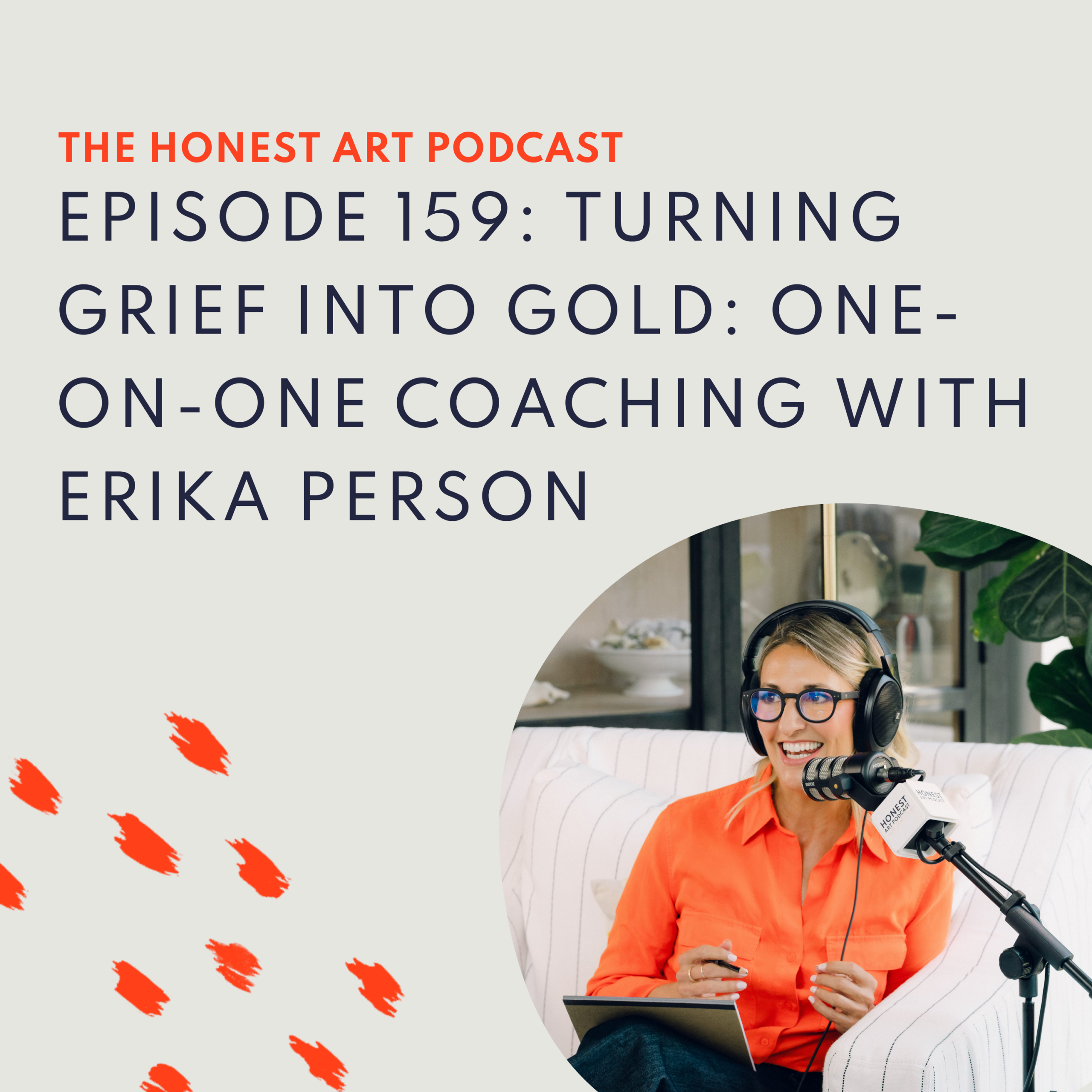
Episode 159: Turning Grief Into Gold: One-on-One Coaching with Erika Person
CLICK HERE TO LISTEN TO THE EPISODE
Turning Grief Into Gold: One-on-One Coaching with Erika Person
There is a Japanese art called kintsugi that mends broken pottery with gold, so the break becomes the most beautiful part of the piece instead of the part you hide. It is a strange thing to build an entire art business coaching call around, but that is exactly what happened this week, and it turned into one of the most honest conversations..
Our guest is Erika Person, a member of the Honest Art® Society and a former opera singer who found abstract painting after a neck injury ended her singing career, and after she lost both of her parents six and a half months apart. She is also a breast cancer survivor. If anyone has earned the right to talk about what it means to paint from the broken places, it is Erika.
The Japanese Art That Explains Why You Feel Broken
Kintsugi is the practice of repairing broken pottery with gold lacquer, so the crack becomes part of the design rather than a flaw to disguise. Erika found the practice in the middle of early grief and built an entire series of small paintings around it, called, Healing Hearts, most of them titled, “More Beautiful Than Before.” As Jodie put it on the call, “let’s not hide the places we feel broken. Let’s highlight them.” That is the whole philosophy behind Honest Art® in one sentence: the parts of your work, and your story, that feel too raw to show are usually the parts your collectors are most drawn to.
If this theme resonates, Episode 56: How Art Helps Us Heal goes deeper into why painting is so uniquely suited to processing grief and loss.
Why Your Story Sells the Work (Not Just the Painting)
Erika raised a real problem for abstract painters specifically: her work is inspired by words and music, but without the story behind it, people can’t always feel the meaning. Jodie’s answer was direct. People don’t buy art because they see it. They buy art because they feel something, and the story is almost always what creates that feeling. A friend of Jodie’s sold out her entire first solo show by writing five or six sentences next to each painting. Not an artist statement. Not a wall of text. Just enough story to create the emotional connection that makes someone want to own the piece.
Stop Hiding, Start Standing Out
Erika’s question going into this call was about standing out, a question almost every artist eventually asks. Jodie’s answer: standing out never starts with the work itself. It starts with understanding your own why, the specific reason you chose this creative outlet over every other one available to you. Trying to make “palatable” art instead of honest art creates an energetic disconnect that people can feel, even if they can’t name it. The artists who stand out are the ones willing to paint unfiltered, scars and all, instead of trying to appeal to everyone. As Jodie said, “if we try to appeal to everyone, we will appeal to no one.”
For more on the identity work underneath this, check out Episode 87: How Imposter Syndrome is Holding You Back as an Artist (& What to Do About It).
Treat Your Art Like the Business It Actually Is
This is where the conversation turned practical. Jodie’s cookie company analogy says it best: you can have the best cookies in the world, but if you make dozens of them and just wait for people to show up, nobody buys. The same is true for art. You need an email list. You need to know what quarter you’re in and what you’re building toward, because waiting until November 15th to plan a holiday collection is already too late. And you need multiple revenue streams, because relying on one channel, like a single gallery or Instagram alone, is fragile.
If you’ve been putting off your email list, Episode 67: Fight Me! Yes, An Artist Needs An Email List with Yasmine Kashefi makes the case in full.
The Three Circles That Actually Matter
Jodie described her Rebel Trifecta using a simple Venn diagram: one circle is your art (strong, meaningful, honestly made), one circle is business skills (getting your work in front of people), and one circle is mindset (the beliefs that let you actually do the first two). Magic happens in the middle, where all three overlap. Skip mindset, and even great art with solid business tactics stalls out, because fear of being seen will quietly keep you from sending the email, applying to the show, or raising your prices.
Erika shared how much old grief-related trauma surfaced once she started doing this work, including a deeply rooted belief that it doesn’t matter what she does, she can’t get what she wants. Naming beliefs like that out loud is the first step to dismantling them. For more on this specific kind of work, Episode 31: Artist’s Money Mindset: What Do You Really Believe Is Possible? is a natural next listen.
Do It Scared
One of the most quotable moments of the episode: Jodie admitting that after 23 years of building a seven figure art career, she still does most of it scared. If you’re waiting for the fear, or the confidence, to disappear before you send the email, apply to the show, or post the painting, it will never happen. The instruction is simple and almost annoyingly effective. Decide, then do the scary thing.
This pairs directly with the perfectionism conversation later in the episode, especially relevant now that AI-generated content is everywhere. Jodie’s take: showing up polished and flawless is the fastest way to become forgettable. Related listening: Episode 84: How Artists Can Let Go of Perfection and Play More with Nina Berenato.
Permission to Rest When Grief Shows Up
Grief is physically exhausting, and Erika spoke candidly about needing her body to rest after losing both parents so close together, and about the cultural pressure that ties productivity to worth. Jodie’s response was a reminder every artist needs occasionally: some artists don’t touch the studio for two months, or even two years, and that isn’t a failure. It’s part of being a person who makes things.
The Three Analytics That Actually Matter
Erika raised a great business question near the end of the call: you can’t track what you don’t measure, but most artists (Erika included) resist anything that “involves math.” Jodie’s answer strips analytics down to three simple, non-mathy actions:
- 🎯 Put something on the calendar once a quarter. A show, an open studio, a collaboration. A goal without a plan is just a wish.
- 🎯 Send one email a month, minimum. Start your list well before you need it, not the month you want to launch a collection.
- 🎯 Show up consistently on social media once or twice a week. Not to become an influencer. Just to be findable.
For a deeper breakdown of what to actually track (and what you can safely ignore), see Episode 144: What to Track in Your Art Business (And What to Forget About).
Resources Mentioned
- The Artist Who Gets Paid, Jodie’s 3-part workshop (August 20, 25, and 27): https://www.jodiekingart.com/artistseries
- Studio Elite Mastermind applications: www.jodiekingart.com/studioelite
- Follow Erika Person on Instagram: www.instagram.com/erika_person
- Erika Person’s website: www.erikaperson.com
- Honest Art® Society (Erika’s community): jodiekingart.com/has
- Have a question for Jodie? Ask it here: https://forms.gle/hxrVu4oL4PVCKwZm6
- How are you liking the Honest Art® Podcast? Leave us a review on your favorite podcast platform and let us know!
- Watch this full episode on my YouTube channel: https://www.youtube.com/playlist?list=PLMquJfuMsSg0fr46BRdia1cWd-81GThzF
🎬 Watch on YouTube
- 🎬 New to Honest Art®? Start Here: youtube.com/playlist?list=PLDRbtjrfQyOs
- 🎨 Painting Techniques: Best Of: youtube.com/playlist?list=PLW9oZj4G3KkA
Want More from Jodie?
Learn from Jodie:
- 🎨 Studio Elite Mastermind: jodiekingart.com/studioelite
- 🎨 Color Course for Rebels: jodiekingart.com/ccfr
- 🎨 Honest Art® Workshops: jodieking.com/workshop
Jodie’s favorite resources:
- ✍🏻Check out my free guide on how to hang and wire a painting: https://www.jodiekingart.com/how-to-hang-a-painting
- ✍🏻Get my top 10 studio tools here: https://www.jodiekingart.com/10-studio-tools-opt-in
- ✍🏻Learn 5 things they don’t teach you in art school: https://jodieking.com/work-with-me#free-rescources.0
- ✍🏻See Jodie’s favorite things: https://www.amazon.com/shop/jodie_king_
- 🧘🏼♀️Guided Meditation for Creative Clarity: https://www.jodiekingart.com/guided-meditation
This episode is for general educational purposes and reflects the personal experiences and opinions of the host and guest.
This post may contain affiliate links. Jodie King Media may earn a small commission at no extra cost to you.
July 21, 2026
Leave a Reply Cancel reply
@ jodie_king_
© JODIE KING 2022
All Rights Reserved
Site Credit
Contact us
Legal
Get where you need to go

Follow On Facebook
PIN WITH ME
I make Videos for You
JOIN THE GRAM FAM
I’m Jodie – an educator, entrepreneur and professional artist. Whether you’re a beginner or an experienced painter, my Color Course for Rebels, Art Biz For Rebels, NFTs for Rebels, and in-person workshops are going to equip you with everything you need to bring your painting, business and joy to the next level. Join me and let’s have some fun!
Be the first to comment